RAILYARDS
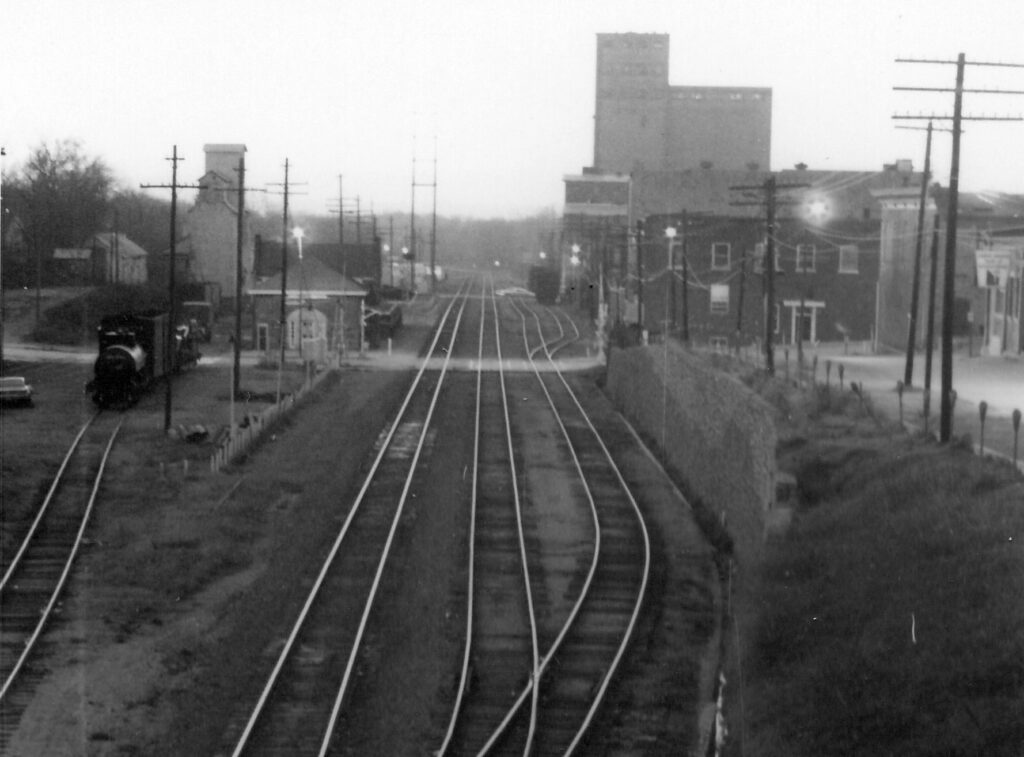
Photo: Warrensburg, MO Rail yard, Evening, May, 1969.
What to know:
1. Rail yards are subject to local weather effects such as stagnant air, heat domes and wind effects from nearby tall buildings.
2. Because of the nature of the activity, rail yards may have relatively high levels of air pollution including diesel exhaust, detritus and fine particulate containing silica.
3. High amounts of hydrocarbon pollution in the soil may be found in and near rail yards.
In the United States, rail yards are part of America’s deep history. Construction began on the Altoona Pennsylvania’s rail yard in 1850.1 The North Little Rock (Arkansas) Rail Yard was built in 1869 in a town called Argenta–which was eventually annexed by the much larger city of North Little Rock. Work on the massive 780-acre J.R. Davis yard in Roseville, California was originally begun between 1906 and 1910.2 Union Pacific’s 2,850-acre Bailey Yard–the largest rail yard in the United States–was built in North Platte, Nebraska, beginning in 1866 and began operation the following year. The town of Moberly, Missouri was formally established in 1866, with the Union Station and rail yard opened to the public just three years later on December 11, 1889.
The engineers and planners who designed the rail yards tried to find stretches of land that were flat, or in some cases, included land that inclined uniformly in one direction or another–a geographical feature that would enhance rail car sorting operations. For example, one Las Vegas railyard did not have a small hill (hump) ordinarily used to assemble the train or consist. Instead, the yard was reportedly higher at the western end than at the eastern end, and thus, switchmen would use this difference in altitude to move cars into the preferred sequence in the train. As one switchman who worked the Las Vegas rail yard pointed out to me, “here, we use gravity.”
Airborne pollutants at rail yards
Railroad activity in rail yards can result in airborne pollution. The pollution may be in the form of particulates (rust, diesel exhaust particles, silica from sand, and, depending on the date and age of the locomotives, asbestos) as well as carbon dioxide, carbon monoxide, sulfur dioxide, and possibly polynuclear aromatic compounds from internal combustion engines. Given that diesel fuel and lubricants may have chemicals added as smoke suppressants, wear inhibitors, heat transfer agents, and additional lubricants. These additional chemicals can include metals, chlorine (to increase pour point and improve viscosity)3 and dimethyl silicones (to improve steel-on-steel lubrication.
Hydrocarbons of various kinds are not the only things that can be added to diesel fuel. The metal cerium can be added to diesel fuel to serve as a catalyst.
A paper by Jane Y.C. Ma et al (2014) was titled “Interactive effects of cerium oxide and diesel exhaust nanoparticles on inducing pulmonary fibrosis.” The authors of that article reported that cerium can be emitted as nanoparticles of cerium oxide capable of inducing pulmonary fibrosis. Dr. Ma noted in the abstract that “using CeO2 as diesel fuel catalyst may cause health concerns.”5
Cerium also turns up in an article by researcher and author Richard Paul. In his Dieselnet article, “Filters using fuel borne catalysts,” 6 he reported that “metal-based fuel additives were first studied as smoke suppressants and cetane improvers. Several metals, including barium, calcium, iron, cerium and manganese have been found effective in lowering the amount of soot formed during combustion in both diesel and SI (spark ignition) engines.”
In 1999, K.A. Berube, T.P. Jones et al authored a paper titled “Physicochemical characteristics of diesel exhaust particles: factors for assessing biological activity.” The article was published in the May issue of Atmospheric Environment.7 In the article, Berube et al described four categories of diesel nanoparticles by morphology. Among the morphology types were “clusters of spherulites.” Using electron probe ex-ray analysis, Berube, Jones, et al identified a variety of elements among diesel exhaust nanoparticles, including: carbon, oxygen, sodium, magnesium, potassium, aluminum, silicon, phosphorus, sulfur, chlorine and calcium. They also identified a “range of metals that they termed “heterogeneous” in distribution: titanium, manganese, iron, zinc and chromium. Finally, they turned to an old analysis technique called inductively coupled plasma/mass and atomic emission spectrometry and a new technique called water sonication that used 20,000 Hz ultrasound) to identify magnesium, phosphorus, calcium, chromium, zinc, strontium, molybdenum, barium, sodium, iron, sulfur and silicon.
Berube, Jones et al concluded that “comparison of microscopy and analytical results between sonicated and impacted diesel exhaust particles revealed a physicochemical difference that must be taken into account in any toxicological investigation.”8
Finally, in addition to everything else, rail yard air is often contaminated with diesel exhaust smoke–which has been linked with dioxins such as tetrachlorodibenzo-para-dioxin (TCDD.)
Specific studies of rail yard pollution
Several peer-reviewed scientific papers have examined air pollution in and near large rail yards.
One such paper, from 2019 by Brantley et al9., examined air pollution sources near Atlanta’s Inman/Tilford rail yard. The researchers found:
• “Calm or variable wind conditions significantly increased the concentrations of all the pollutants measured, with the greatest effect on the nitric oxides which increased by a factor of 1.5 to 2 depending on the pollutant and model, and the smallest effect on CO (carbon monoxide), benzene and acetaldehyde, which increased by factors of 1.1 to 1.2.10
• “Near-source studies commonly focus on time periods of cross-wind conditions to clearly isolate spatial gradients in pollution attributed to the source. However, low-speed mixed winds during calm periods can limit the dispersion of emissions in the immediate vicinity of the rail yard as well as in the surrounding urban area, resulting in higher concentrations.”11
Other researchers studying rail yards and rail lines have reported higher than average particulate pollution:
• “Measurements of PM2.5 (airborne particulate matter 2.5 microns or smaller in diameter) show that living close to the rail lines significantly increases PM2.5 exposure. For the one month of measurements at the Seattle site, the average PM2.5 concentration was 6.8 μg/m3 higher near the rail lines compared to the average from several background locations. Because the excess PM2.5 exposure for residents living near the rail lines is likely to be linearly related to the diesel rail traffic density, a 50% increase in rail traffic may put these residents over the new U.S. National Ambient Air Quality Standards, an annual average of 12 μg/m3.”12
Weather
Weather can substantially affect work in rail yards. Switchmen are particularly subject to wind effects including dust in the air. Rail yards in or near large cities, may be subject to local weather conditions such as increased temperature from the local city heat island, or pollution trapping due to the meteorological inversions–where the air temperature increases with height rather than decreasing, as would be normal. In this situation, the cooler air at the ground is trapped beneath a “lid” of warmer air. As a result, pollution cannot disperse and builds up as a visible haze.
A similar condition can occur if the rail yard is in a geographical basin13. Los Angeles, for example, is surrounded by mountains to the east and north. As a result, high-pressure weather conditions such as the Pacific anticyclone14 can result in very high levels of pollution.
If rail yards are in a basin, or surrounded by hills or mountains, there is a high probability that pollution trapping may occur when the air is stable, i.e. during high pressure conditions. This would mean that pollution could build up over the yard and trap particulate and diesel exhaust within the breathing zone of those working in the yard.
Ground Pollution
In 2023, in partial fulfillment for his Master of Science degree, Terrance DeWayne Overstreet authored a 104-page thesis evaluating community ground pollution resulting from waste disposal at the Englewood Rail Yard in Houston, Texas.15
In his study, Overstreet analyzed data from the EPA, the Houston Health Department and the Texas Department of State Health Services, to report soil contamination in communities near the Englewood site, the result of improper release of wastewater into drainage ditches. According to Mr. Overstreet’s paper, the releases began in 1984. The source of the contamination included a wood treatment plant, a classification yard and a tanker storage facility. The chemicals identified in the soil included arsenic, benzene, benzo(a)pyrene, bis(2-ethylhexyl) phthalate (DEHP), creosote, 1,2-dichloroethane, 1,2-diphenylhydrazine, 2,4-dimethylphenol, 2-methylnaphthalene, fluorine and fluoranthene.16
Using data from the Environmental Protection Agency and other sources, Mr. Overstreet compared other U.S. rail yards, including: Conrail Rail Yard in Elkhart, Indiana; Union Pacific Rail Yard in Eugene, Oregon, the Paoli Rail Yard in Paoli, Pennsylvania and the CSX Rail Yard in Waycross, Georgia.17
• The Conrail rail yard site in Elkhart, Indiana was found to have contaminated groundwater and soil from “improper disposal of track cleaner by burning waste,” and “improper disposal of tank cars by underground burial.” This occurred at both the classification yard and the distribution yard from 1976 to 2014. The chemicals included: chloroform, tetrachloromethane; 1,1-dichloroethane; 1,2-dichloroethane, trichloroethylene, tetrachloroethylene (perchloroethylene) and vinyl chloride.
• A rail yard in Eugene, Oregon was contaminated by “improper release of wastewater to nearby drainage ditches” from such sites as the locomotive maintenance and fueling area, railcar repair, wood treatment plant and wastewater treatment and disposal area from 1990 to 2015. The chemicals included creosote; 1,1-dichloroethylene (DCE), polycyclic aromatic hydrocarbons (PAHs), trichloroethylene (TCE), tetrachloroethylene (PCE) and vinyl chloride.
• The rail yard in Paoli Pennsylvania was contaminated due to “improper storage of railroad ties and hazardous debris in the rail yard.” The source of the chemicals included the distribution yard, locomotive maintenance, tanker storage and the repair facility from 1986 to 2021. The chemicals included benzene, biphenyls (possibly polychlorinated biphenyls), ethylbenzene, toluene and xylenes.
• The rail yard in Waycross, Georgia site was contaminated due to “improper storage and accident(al) releases to the ground” from “1988 to present.” The releases occurred at the distribution yard, the maintenance facility and the storage facility. The chemicals included arsenic, benzo(b)fluoranthene; 1,1-dichloroethane; 1,1-dichloroethene, cis-1,2-dichloroethane, trichloroethene, trans-dichloroethene and vinyl chloride.
The polynucleated hydrocarbons listed, such as creosote and 2-methylnaphthalene all have low vapor pressures; that is, they are not easily vaporized into the breathing zones of workers. For example, at 77°F, creosote has a vapor pressure of 11.1 mm and 2-methylnaphthalene has a vapor pressure of 0.05 mm Hg (millimeters of mercury at 77 degrees F). Other hydrocarbons that may be present from past operations, trichloroethylene, for example, can volatilize more easily at moderate temperatures, and may be found as trace components of the air in industrial sites near rail yards.